
Watauga Projected Versus Actual Release
North Carolina uses the term projected release date for a computed estimate. It can be established after NCDAC reviews the judgment, sentence structure, confinement credit, and applicable rules. An actual release date is a recorded event after custody ends in that system. These dates answer different questions. A projection is useful for planning and notifications, while an actual release entry supports a statement that the person left the named custody system.
A pretrial detainee usually has no sentence-based projected date. Release may instead depend on bond, a court order, dismissal, plea, trial result, transfer, or another hold. A sentenced county-jail prisoner may have a computation maintained by the Watauga County Detention Center. A state prisoner is tracked through NCDAC. The same person may move between these stages.
| Record | What it means | Where to confirm |
|---|---|---|
| Projected release date | Current estimate based on the sentence computation | NCDAC OPI or responsible jail records |
| Actual release date | Recorded departure from that custody system | OPI history or Sheriff release entry |
| Active supervision | Physical custody may have ended while legal control continues | OPI Active Probationer/Parolee and judgment |
Find Watauga Projected Release Dates
Start by identifying the custody system. For a state prisoner, use the NCDAC Offender Public Information search. Its database contains state prison and community-supervision records back to 1972 but excludes a jail-only Watauga booking. Search by offender number when possible. A name search should add birth date or age and compare the full history to prevent a namesake mistake.
- Obtain the court case number, judgment, and offender or booking number when available.
- For state custody, search OPI and select the matching record by identity and history. Read current status before looking at any date.
- Distinguish the projected field from an actual release-history entry and from an Active Probationer/Parolee status.
- For a Watauga jail sentence, call 828-265-7614 and ask how to obtain the existing calculation and release record.
- Check the Watauga judgment for active or suspended terms, concurrent or consecutive structure, confinement credit, and later orders.
- When a date has passed, check the current agency record, SAVAN notice, and any transfer or hold rather than assuming release.
The NCDAC monthly Inmate Releases tool offers Watauga, year, and month fields. It helps find actual state-prison releases by reported release county. It is not the Watauga jail log and does not provide a live projected-date calculation.
Watauga Release Minimum Sentence Rule
North Carolina's key Structured Sentencing rule appears in G.S. 15A-1340.13(d). A person sentenced to active punishment must serve the judicial minimum. Earned-time credit may reduce the maximum term, but it cannot reduce the term below that imposed minimum. This is the local projected-release calculation's most important floor when the Watauga judgment results in a covered state sentence.
There is no blanket North Carolina law that makes every sentence an 85-percent calculation. The accurate statement is that 100 percent of the imposed minimum must be served, while qualifying credit can reduce the maximum no lower than that minimum. A rough percentage can mislead because statutory maximums may also include months linked to post-release supervision.
The official structured-sentencing table source shows how statutory minimum and maximum terms work:
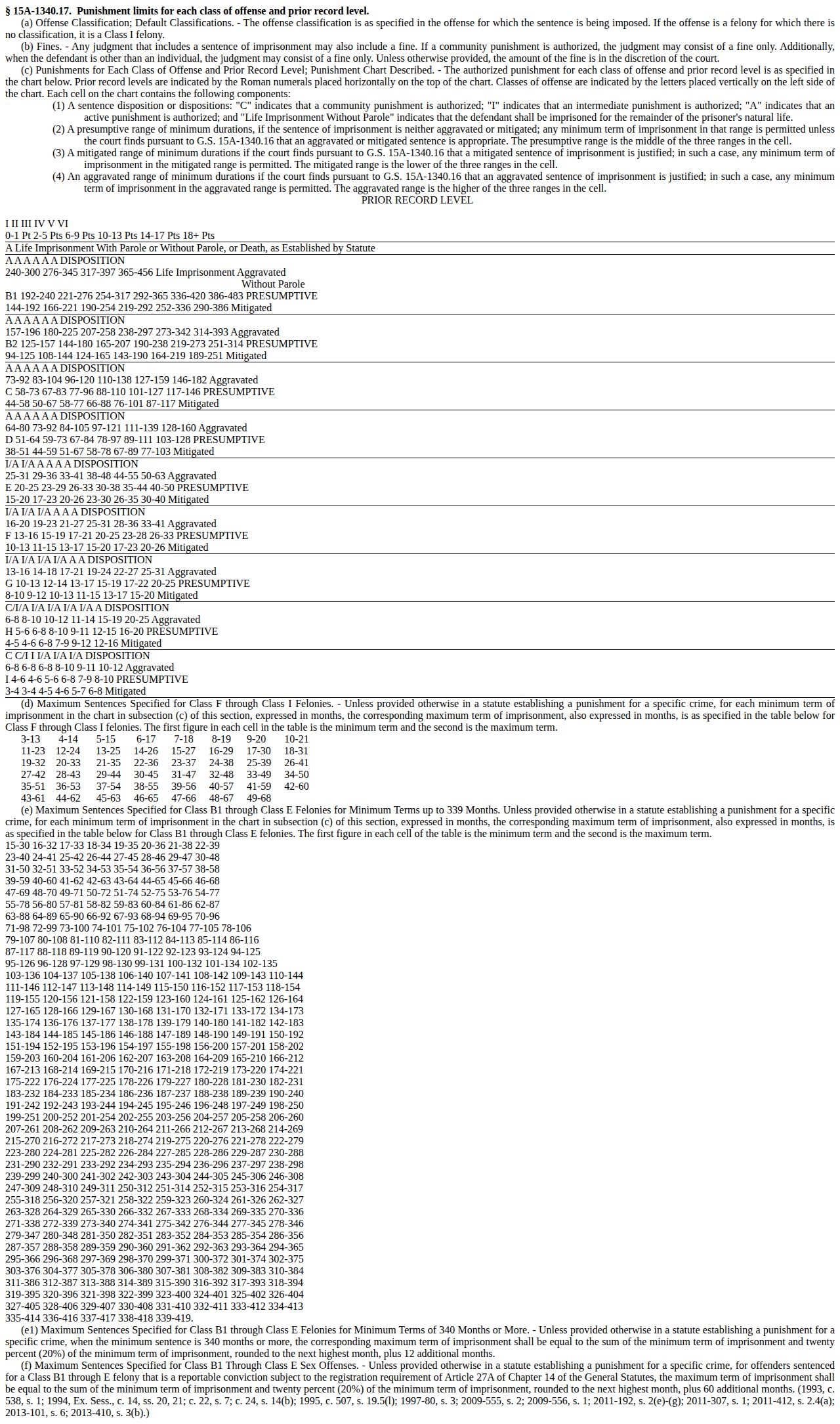
The judgment's offense class, prior-record level, and selected range must be read from the actual case. A table should never be used to reconstruct a sentence from an article or charge summary.
Watauga Release Credits and Custody
G.S. 148-13 authorizes the DAC Secretary's earned-time rules and directs local jail administrators to follow applicable rules for sentenced jail prisoners. Current NCDAC Institutions Policy C.3000 addresses Good, Gain, Earned, Discretionary, and Meritorious Time for DAC-sentenced people held in institutions, jails, or private facilities. The policy also states that these credits do not determine parole or post-release-supervision eligibility.
G.S. 15-196.1 provides credit for qualifying confinement before sentence. That credit must be applied to the actual commitment, not guessed from arrest and news dates. Discipline can lead to a change or loss under applicable rules, and later correction may alter the displayed projection.
- Minimum term
- The judicial floor that an active Structured Sentencing term must reach.
- Maximum term
- The longer statutory term from which qualifying credit may be applied.
- Confinement credit
- Qualifying time spent confined before judgment that is credited under law.
- Consecutive terms
- Sentences served one after another rather than at the same time.
Watauga Jail Release-Date Calculation
No Watauga-specific public good-time policy was located. That absence makes a do-it-yourself day count unsafe. For a sentence served at the Watauga County Detention Center, obtain the signed judgment, commitment, qualifying pretrial-credit record, and the jail's existing computation. Ask the custodian which applicable DAC rules were used and request the actual release entry once processing is complete.
The Sheriff operates the jail, while the court controls the judgment. The Watauga courthouse record can show whether a term is active or suspended, the sentence length, probation, credit, and later orders. It may not show the exact minute jail staff processed departure. For documentary proof, pair the court order with the Sheriff booking and release record.
Note: The Detention Center has published no local formula, so subtracting reported days from a sentence can omit credit, holds, or later orders.
Why Watauga Release Dates Change
A projection reflects the facts known to the computing agency at that time. It may change when the judgment is corrected, credit is added, sentence structure is clarified, discipline affects earned time, or another lawful event changes the custody path. A detainer is a hold or request from another authority. It can mean departure from one facility leads directly to another agency instead of community release.
| Factor | Effect on the date or event | Record to check |
|---|---|---|
| Confinement credit | Qualifying time may be added to the computation | Judgment, credit record, agency calculation |
| Earned-time change | Credits may alter the maximum-term computation | NCDAC policy and current record |
| Consecutive sentence | Another term follows the first | Signed judgments and OPI history |
| Court order | Correction or later ruling may change legal custody | eCourts and clerk file |
| Detainer or transfer | Departure may lead to another custody system | Release entry and receiving agency |
| Parole review | An eligible older-law case may receive a decision | Commission result and later OPI status |
A favorable parole review is not the same as a completed departure. For modern Structured Sentencing, release to post-release supervision is set by law rather than granted as a discretionary reward. Each event needs its own dated source.
When Watauga Projections Have Passed
A date in the past does not automatically prove release. Open the current OPI record and look for an actual release-history event or current Active Probationer/Parolee status. If the person was held only in Watauga, ask the Detention Center for the release date, time, reason, and receiving agency. A transfer can end Watauga custody while another agency continues confinement.
Keep the as-of date whenever a projection is recorded. A later viewer can then tell whether the number came before a recalculation, discipline decision, sentence correction, or added hold. If OPI still shows an active inmate after the projected day, treat the live status as the current answer and ask NCDAC records about the computation. If OPI shows active community supervision, physical prison custody may have ended while the legal sentence continues outside the institution.
Identity must also be rechecked. A past projection in an older inactive state record may belong to a different sentence or to a namesake. Compare offender number, birth information, offense history, admission data, and the Watauga judgment. When the match is sound but the current record is unclear, NCDAC's public-records channel can supply existing public admission, sentence-length, time-served, release, and supervision facts tied to that offender number.
NC SAVAN can support a custody-change check for a matching participating record. Its updates may lag, and a transfer may require new registration. The Watauga VINELink inmate search process is most useful when registration occurs before the expected event. A SAVAN alert should still be paired with the Sheriff, NCDAC, court, or receiving-agency record.
Watauga Actual State Release Search
The monthly NCDAC release form is an actual-release discovery route for state prisoners, distinct from OPI's individual projection. Users can select Watauga, a displayed year, and month, or search a surname with Soundex. The interface also contains categories for an unreported county and release to another state, which shows why the Watauga filter is not exhaustive.
The official NCDAC monthly form is shown in this source image:
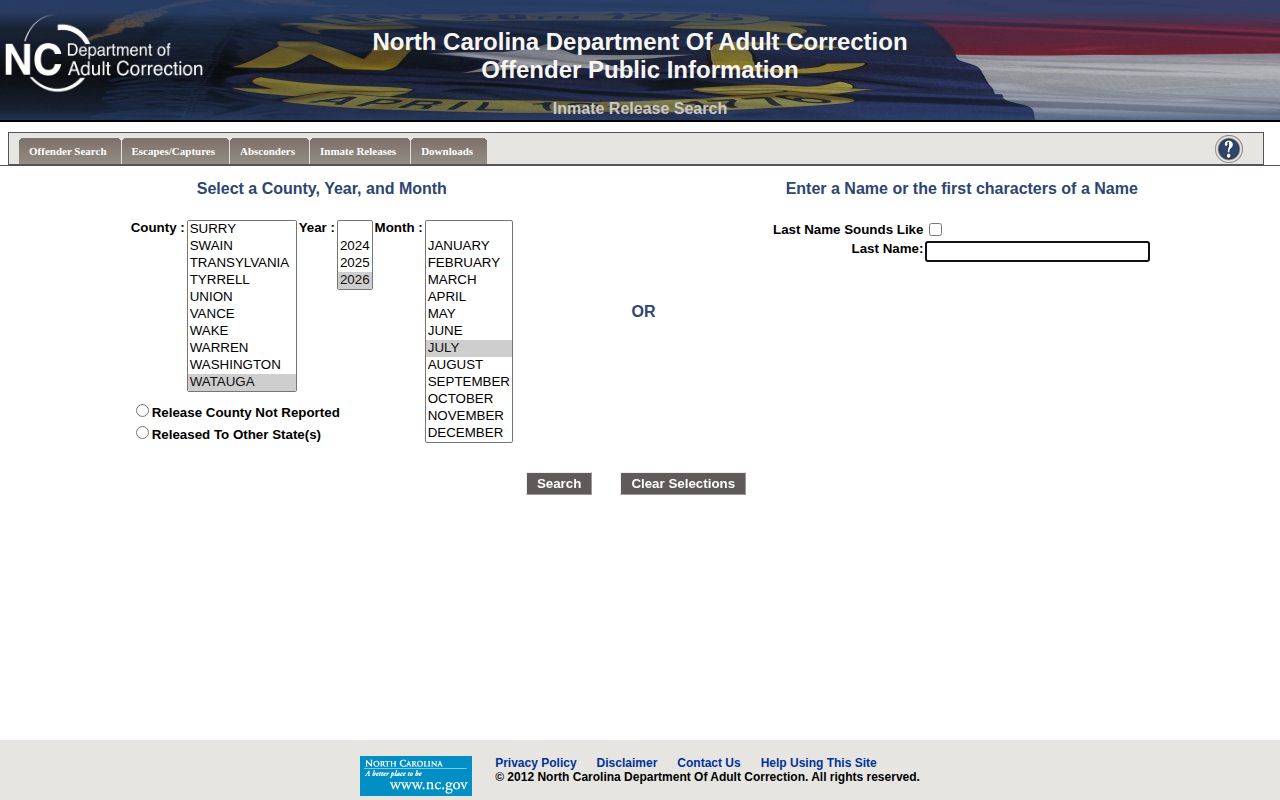
A listed state release should be matched back to the individual OPI history. It does not document a county-jail release, nor does it turn the monthly source into a 24-hour or 72-hour Watauga feed.
During the Watauga research, the form offered release years 2024 through 2026. That interface range may change, so the available year menu should be read at search time. A missing county-month result does not settle custody because the form also accounts for unreported release counties and releases to other states. Use the offender number and individual history for confirmation.
Confirm Watauga Actual Release
Use the source that controlled the custody. For a Watauga jail event, seek the Sheriff's release entry. For a North Carolina prison term, read the current OPI status and actual history. For the legal sentence, obtain the Watauga judgment and later orders. When documentary proof matters, Watauga County release-record access identifies the fields to request and the custody boundaries.
Keep the wording narrow. “Projected for release” describes an estimate. “Released from Watauga custody” describes a county event. “Released from prison and under DAC supervision” describes a state status that remains active. “Transferred” means another system must be checked. Precise labels prevent a date from being mistaken for a final discharge.