
Watauga Probation and Parole Differences
Probation is a court-ordered form of community supervision. It may be imposed instead of an active prison term or after a suspended sentence. Parole is conditional release before an older eligible sentence expires. Post-release supervision is the modern form of supervised release that follows many Structured Sentencing prison terms. North Carolina enacted Structured Sentencing in 1994, and the Post-Release Supervision and Parole Commission explains that parole was eliminated for ordinary offenses governed by that system. Older-law cases and limited statutory categories can still receive discretionary parole review.
The labels matter because they identify the source and the legal stage. The court judgment establishes probation. NCDAC maintains the public correctional and supervision record. The Commission sets post-release conditions and decides eligible discretionary parole matters. Physical release does not mean every duty ended.
| Status | How it begins | Best public check |
|---|---|---|
| Probation | Court judgment, often tied to a suspended sentence | eCourts judgment plus OPI Active Probationer/Parolee |
| Post-release supervision | Release from a qualifying Structured Sentencing prison term | OPI status/history and NCDAC supervision office |
| Parole | Commission approval for an eligible older-law or special case | Commission review result followed by OPI actual status |
- Discharge
- The official end of a correctional or supervision status.
- Absconder
- A supervised person whom DAC identifies as actively avoiding supervision.
- Detainer
- A request or hold that can lead to custody by another authority.
Verify Watauga Post-Release Supervision
The direct public route is NCDAC's Offender Public Information search. It covers North Carolina state prisoners, probationers, and parolees back to 1972. It does not contain a county-jail-only booking unless the person also has a DAC custody or supervision record. A recent Watauga case should therefore be matched to the court judgment and Sheriff release record rather than proved by an older state entry.
- Search by offender number when it is known. Otherwise combine the full name with date of birth or age and compare the record history.
- Choose Active Probationer/Parolee to test for present community supervision. Use Inactive only to review a person formerly active in DAC.
- Open the correct record and read the supervision, release, offense, and sentence history together. An active supervision label can follow physical prison release.
- Check the Watauga court judgment for probation terms, a suspended or active sentence, credit, and later orders. A disposed case does not always mean supervision ended.
- Use the district directory to route a current-status question, then seek the official record when documentary confirmation matters.
Watauga Supervision District 24
Watauga belongs to Community Supervision Judicial District 24 with Avery, Madison, Mitchell, and Yancey counties. The current NCDAC district and local office directory lists the district manager in Mars Hill. That directory is the safer routing source because an older Watauga reentry sheet lists a Boone office that may no longer be current.
Community Supervision Judicial District 2422 N. Main Street
Mars Hill, NC 28754
828-689-8967 or 828-689-8968
Call before travel and ask which office holds the identified case. District management contact does not mean every Watauga-supervised person reports in Mars Hill. Interstate transfer can also place reporting responsibility in another state without ending the North Carolina judgment.
The official supervision directory shows the structure used for Watauga County in this captured reference:

The long directory should be used for office routing, while a person's actual status must come from the matched OPI record and responsible office.
Watauga Probation Absconder Records
NCDAC maintains a separate Absconder search with surname, Soundex, and county-of-supervision fields. Selecting Watauga can locate a matching public supervision flag. The result is not a release record, warrant docket, or statement that officers have taken the person back into custody. It means DAC identifies unresolved avoidance of probation or parole supervision.
Confirm the identity and live status with DAC. A person can be outside prison and still violate supervision. Conversely, an absconder result does not show final case disposition or prove the location of the person. Check the court record for later orders and use the supervising office for the correctional status.
Note: An absconder flag indicates unresolved supervision; it is neither successful discharge nor proof of a new confinement event.
Watauga Parole Conditions and Violations
Conditions are the rules imposed by the court, Commission, or supervising authority. Their exact terms come from the judgment and correctional record, not from a generic checklist. A reported violation can lead to investigation, a court response, added conditions, revocation proceedings, or another action authorized by law. It should not be described as a new conviction or return to custody without a matching official record.
NC SAVAN/VINELink can carry some probation, parole, post-release, jail, and prison events. It is useful for custody-change notices, but it does not notify users of discretionary parole reviews. A transfer may require registration under a new agency record. The court, OPI, Commission result, and SAVAN alert therefore document separate stages.
Watauga Post-Release Reentry Support
Recovery on the Inside is a local link between detention and reentry. The program began in 2018, works inside the Watauga County Detention Center, develops release plans, and continues support afterward. It also describes pretrial diversion for eligible offenses in coordination with legal and treatment partners. Transportation is part of linkage to care for program participants, not a general ride offered to everyone released from the jail.
NCDAC also publishes a Watauga County reentry resource page. These resources can support a transition, but neither source verifies supervision status. That answer still comes from OPI, the judgment, and the supervising agency.
Watauga Parole Reviews, Not Hearings
North Carolina does not hold formal offender parole hearings. The Commission says it does not personally meet offenders during possible-parole review, so there is no conventional hearing calendar to check. The public cadence and outcome source is the Monthly Discretionary Parole Reviews page, which publishes monthly spreadsheets beginning in September 2024.
Review frequency can be annual or every two or three years based on the offense. Eligibility turns chiefly on offense date and statutory category under G.S. 15A-1371. Published results can include Incomplete Decision, Suspend Decision, Regular Parole, Community Service Parole, Early Medical Release, and 90-day Mandatory Parole. Those terms should remain in the Commission's wording.
The official monthly review page is shown in this source capture:
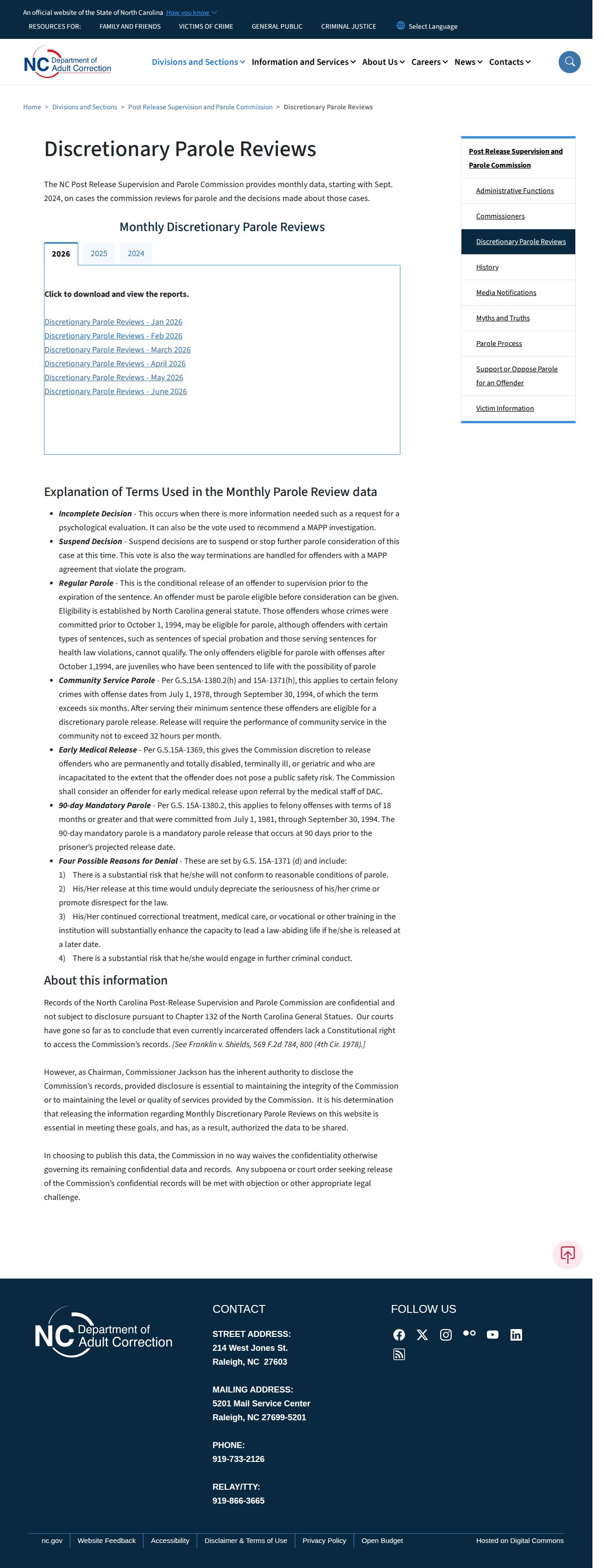
A favorable result is not an actual release entry. Confirm the later status in OPI. Commission records otherwise remain confidential, and monthly publication does not waive that rule. A majority must agree on approval or denial. Under G.S. 15A-1371, refusal can rest on risk of noncompliance, depreciation of offense seriousness, benefit from continued treatment or training, or substantial risk of further criminal conduct. The spreadsheet's decision wording should not be turned into a promised exit date.
Victim Support Services says a victim may contact the Commission about four months before review to arrange an input meeting. That meeting lasts about 30 minutes, is held with one commissioner, excludes the offender, and may include up to five attendees. It is not a public formal offender hearing. NCSAVAN does not send parole-review alerts, so Commission correspondence, the monthly result, OPI status, and a later custody-change notice must remain separate sources.
Watauga Supervision Discharge Records
Supervision ends through an official discharge, expiration, court order, or other authorized action reflected by the responsible system. OPI's Inactive label means the person was once active as an inmate or probationer and is no longer active in those DAC categories. It is not itself a county release reason, and it should be read with the last state history entry and judgment.
A discharge date also needs the right scope. Completion of probation in one case does not prove that another case, sentence, or agency status ended at the same time. Review each Watauga judgment and match its case number to the current correctional history. When an interstate compact record shows supervision moved elsewhere, use the receiving state's information before describing the case as closed. If OPI is incomplete, NCDAC's public-records channel can supply existing public admission, release, sentence-length, time-served, and supervision records tied to the offender number.
For a recent Watauga jail matter, the Sheriff's booking and release record remains the source for leaving county custody. The Watauga County release record process explains that distinct county path. When the prison term ended but OPI still shows Active Probationer/Parolee, use the precise conclusion: released from prison and currently under DAC supervision. Final discharge requires the later correctional or court record.